Welcome to Gulf News, your premier destination for comprehensive coverage and insights into the dynamic landscape of the Gulf region and beyond. As a trusted source of news and information, we pride ourselves on delivering timely updates, in-depth analysis, and compelling stories that resonate with our diverse audience.
From breaking news to in-depth features, business trends to cultural happenings, sports highlights to technological advancements, Gulf News covers it all with accuracy, integrit
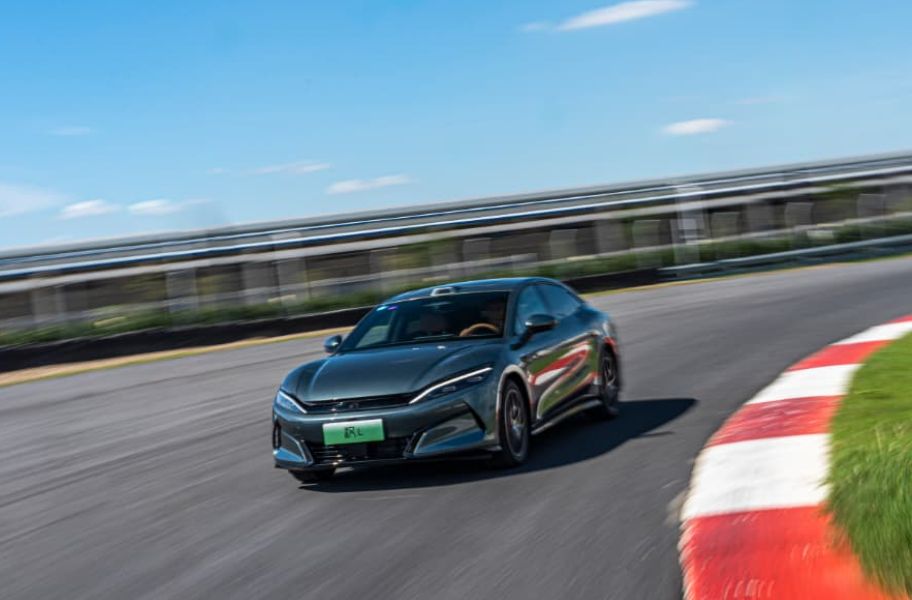
BYD has officially opened its new testing circuit for its ‘new-energy vehicles’ (NEVs) in Zhengzhou, China. The all-terrain circuit features eight experience zones, aimed at ensuring potential buyers put vehicles across different tests to understand their capabilities. These include a race track, water-crossing pool, off-road area, and a sand dune. In addition to the above-mentioned facility in Zhengzhou, BYD has also spoken about its plans to open two more such circuits in Hefei and Shaoxing. Experiences at this facility for customers will start at a little over USD 80 (INR 7,000 approx.).
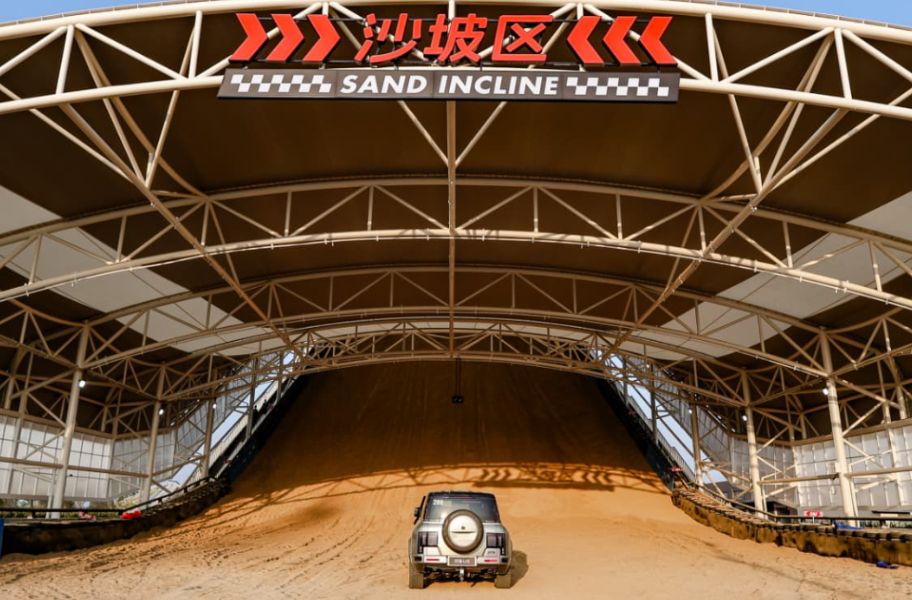
The sand dune section has been certified by Guinness World Records as the highest and largest dune climbing facility for car testing
Part of the track is the Zhengzhou indoor sand dune, which has been constructed with 6,200 tons of sand, meant to mimic the granular composition of the Alxa Desert. This section of the circuit also features a 29.6-meter vertical drop and a 28-degree slope. Remarkably, this site has also been certified by Guinness World Records as the highest and largest dune climbing facility for car testing.
The pool has been designed for the Yangwang U8, which has a water wading capacity of up to 1.4 metres
The circuit also features a 70-metre-long water crossing pool, which has solely been designed for the Yangwang U8, which has a water wading capacity of up to 1.4 metres. Additionally, the kick-plate section on the facility simulates icy road conditions with a wet, polished cement surface, so that visitors can experience emergency situations in a simulated environment.
Another feature of the circuit is the low friction circle which is 44-meter-diameter circular track, consisting of 30,000 smooth basalt bricks with a 3 mm water-covering surface. The company says that users will be able to achieve stable drifting with BYD's millisecond-level electronic control response and intelligent body control system in this zone.
The race track on the facility measures 1,758 metres and includes nine curves
The racetrack measures 1,758 metres and includes nine curves and a 550-metre back-straight section. The dynamic paddock on the facility has an area of 15,300-square-metres with and can be used for standard slalom, moose and automated parking tests. Central to the facility is also an off-road course with 27 off-road scenarios, that span from beginner to advanced levels.
from carandbike - News https://ift.tt/K51vwpH
via IFTTT
Toyota Kirloskar Motor has launched a special edition version of the Camry sedan in the Indian market. Named the Sprint Edition, this iteration of the sedan is priced at Rs 48.50 lakh (ex-showroom), identical to the standard version. The changes on this variant include a range of dual-tone colour schemes, cosmetic add-ons, and a few feature additions. The model, however, remains identical on the mechanical front.
The Sprint Edition is offered in five dual-tone colour schemes, all of which pair the body colour with a matte black hood, roof and trunk. The colour options offered include Emotional Red, Platinum White Pearl, Cement Grey, Precious Metal, and Dark Blue Metallic. Other cosmetic enhancements include a rear spoiler and matte black alloy wheels. This variant also gets door warning lamps and ambient lighting, which are dealer-fitment-level options, at no extra charge.
The Camry Sprint Edition, much like the standard version, continues to get features such as a 12.3-inch touchscreen infotainment system, a fully digital instrument cluster, a nine-speaker JBL audio setup, three-zone automatic climate control, a head-up display, an electric sunroof, and 10-way power-adjustable front seats for both the driver and passenger and more. Its safety kit includes Toyota's Safety Sense 3.0 suite (Level 2 ADAS features), nine airbags and 360-degree cameras, among other features.
Powering the Camry is a 2.5-litre petrol engine mated to an electric motor, delivering a combined output of 227 bhp and 220 Nm of peak torque. The engine is paired with an e-CVT gearbox. The sedan is offered with three driving modes: Eco, Sport, and Normal.
from carandbike - News https://ift.tt/yCqZR7B
via IFTTT
India's automobile sector, which has been struggling with mediocre sales in the last few quarters, is likely to get a major boost ahead of the upcoming festive season. The Union Government, in a major policy decision, is likely to revise the GST rates levied on automobiles to make them more affordable for buyers. A major reform has been proposed, especially for cars below 1,200 cc and two-wheelers below 350 cc. Current varied rates for cars across segments are also likely to be simplified.
Hybrid cars up to 1500 are also likely to see rate cuts
Under the new proposal, taxes on cars that run on 1200 cc or smaller engines are likely to be reduced from the current 28 per cent (plus cess) to 18 per cent. A similar reduction could also be seen in hybrid cars (up to 1500 cc). Most other passenger car segments are likely to be kept in the same category and could attract a flat tax of 40 per cent, and the current cess rates (up to 22 per cent) will determine if the prices will come down or rise. Similarly, two-wheelers that run on 350 cc engines or lower will also see a GST rate cut from the current 28 & to 18 per cent. This will help in bringing the cost down at a time of the year when Indians flock to showrooms in big numbers.
Motorcycles below 350 cc will become more affordable with the new GST rates
Prime Minister Narendra Modi said during his Independence Day speech last week, “This Diwali, I am going to make it a double Diwali for you. This Diwali, you, fellow countrymen, are going to get a very big gift. We started the review by setting up a high-power committee and also held discussions with the states”. A group of ministers set up by the GST Council are likely to meet later this week, after which their recommendations will be forwarded to the Council.
from carandbike - News https://ift.tt/edNx41b
via IFTTT
Hero MotoCorp has just announced that it will launch the all-new Glamour 125 on August 19. The company has teased the motorcycle ahead of its launch, showing us glimpses of what to expect. Having been spied before, the latest version of the motorcycle is expected to receive a significant overhaul over the outgoing model visually, receiving an array of new features in the process.
The teaser primarily shows the new digital instrument cluster in the motorcycle, which appears to be an all-new unit with similar graphics to the Karizma XMR. The cluster unit also has “set speed” written on it, which is likely to be a sign that the motorcycle will feature cruise control, which, if true, will make it the only motorcycle in the segment to get the feature. The presence of cruise control is further The teaser has also shown the motorcycle’s tail section, which gets a taillamp quite similar to the unit on the Karizma XMR, flanked by indicator units.
The Hero Glamour is expected to retain the 125 cc engine on the outgoing model. The current model has a peak power output of 10.68 bhp and 10.6 Nm of peak torque. The engine is paired with a 5-speed gearbox. The motorcycle gets a telescopic fork at the front and dual shock absorbers at the rear, which will also likely remain as it is.
Currently, Hero offers the Glamour 125 in two variants, Standard and Xtec, with prices ranging from Rs. 87,000 and Rs. 90,498 (both ex-showroom, Delhi), respectively. With this update, expect the Glamour to receive a notable price hike, courtesy of all the new features introduced.
from carandbike - News https://ift.tt/e9XwhVn
via IFTTT
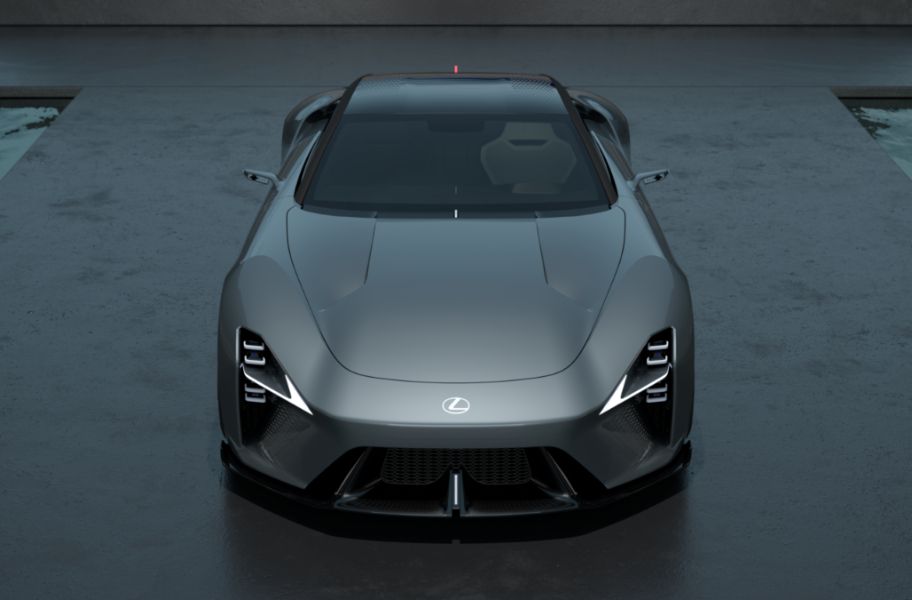
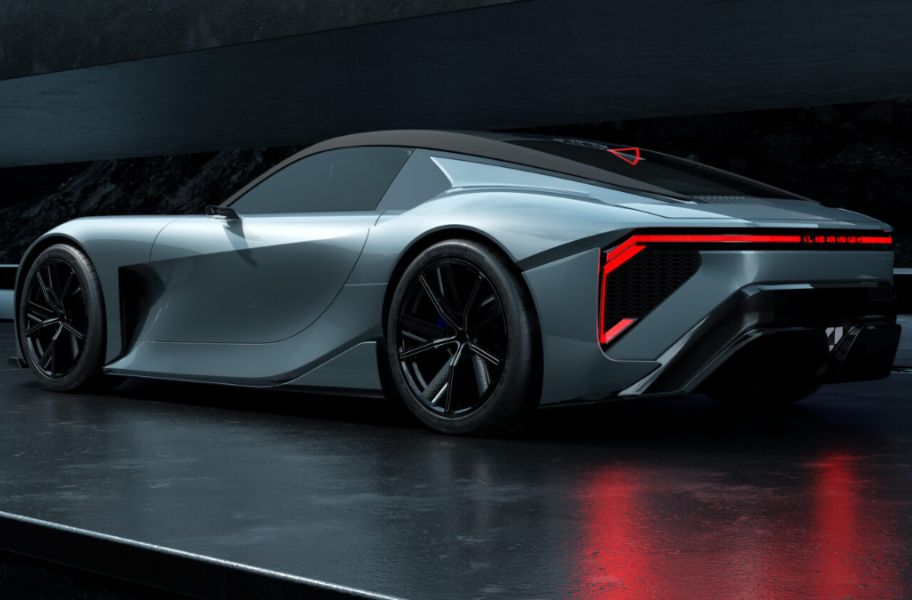
Lexus has now fully unveiled the Sport Concept at the Quail, Monterey Car Week. The concept, which has been spotted testing multiple times, essentially gives us an early preview of what the company’s next-generation sports car will look like. Widely touted as a spiritual successor to the company’s iconic LFA sports car, the production-spec model is expected to debut next year and go on sale in markets across the world.
Visually, the Sport Concept is an edgy-looking sports car with many angular styling cues. The front end features vertical openings for the lighting signatures, flanked by V-shaped daytime-running lamps and a large opening up front. The sculpted bonnet has a pair of vents on both ends, situated close to the curvy fenders, which also incorporate vents on both ends, extruded into the bodywork. Towards the rear, the Sport concept features a rear glass incorporated in a blacked-out section, culminating in a flat deck, with a pair of raised buttresses on both ends.
Technical details about the Sport Concept are currently under wraps, although there have been several speculations. According to reports, the car will feature a twin-turbocharged V8 with some degree of electrification and a rear transaxle gearbox.
from carandbike - News https://ift.tt/3rBXTvn
via IFTTT
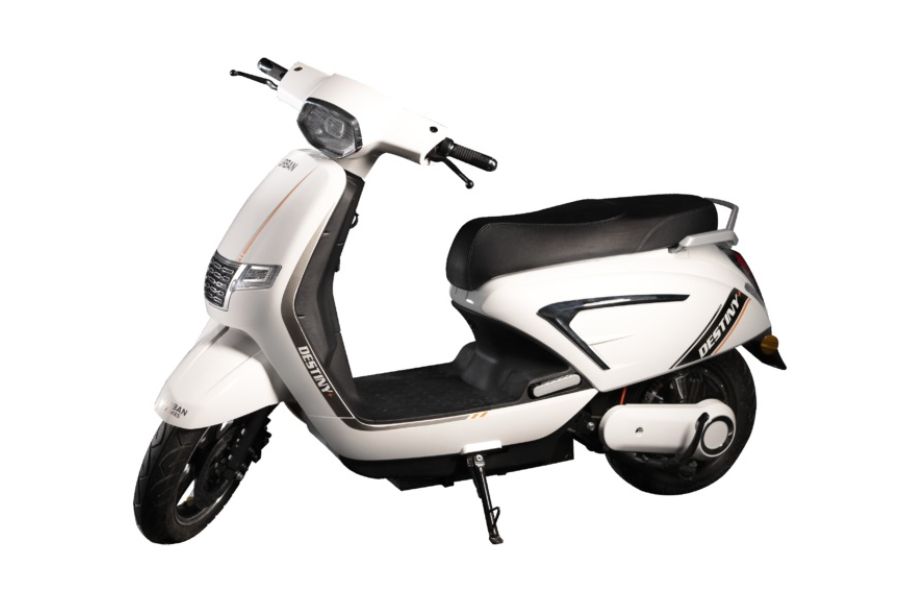
The Delhi High Court has granted an ex parte ad-interim injunction to Hero MotoCorp in its case against Urban Electric Mobility and its associates. Urban Electric Mobility, an EV startup currently manufactures and sells two models in India under the names ‘Destiny’ and ‘Destiny Plus’. This decision comes after Hero had earlier filed a suit against the startup claiming infringement of its ‘Destiny’ trademark. The order was passed on August 13 by Justice Tejas Karia.
Hero MotoCorp has told the court that it is the prior and registered proprietor of the marks ‘DESTINY’, ‘DESTINI’ and ‘DESTINI PRIME’ under Classes 12 and 37. During the case, it was argued that Urban Electric Mobility, by using the nametags for its products, tried to pass itself off as an associate of Hero, likely in an attempt to boost sales and reputation. The startup’s associates-Galaxy EV were also selling and promoting scooters with the same nametags via a commercial arrangement.
It was also pointed out that Urban Electric Mobility was using the mark ‘Hero’, which would potentially cause further confusion among consumers about the origins of the product. With the mentioned findings the court noted that Hero MotoCorp showed strong prima facie evidence, and that the continued usage of the aforementioned nametags by Urban Electric would cause damage to Hero’s reputation. The startup has now, accordingly, been restrained from using, selling, promoting, or manufacturing any products that bear the ‘Destiny’ nametag.
from carandbike - News https://ift.tt/7DSqwG6
via IFTTT
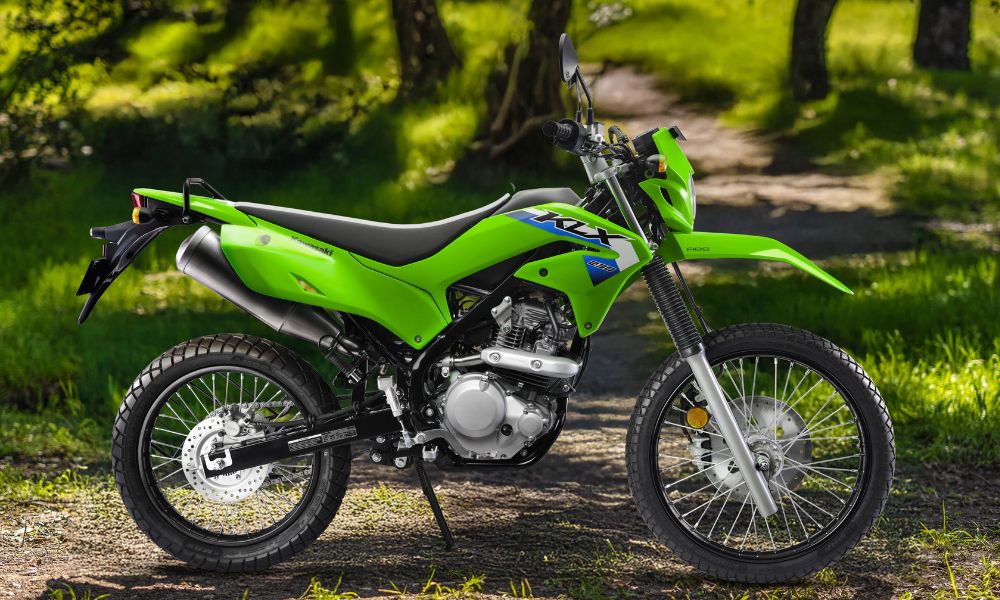
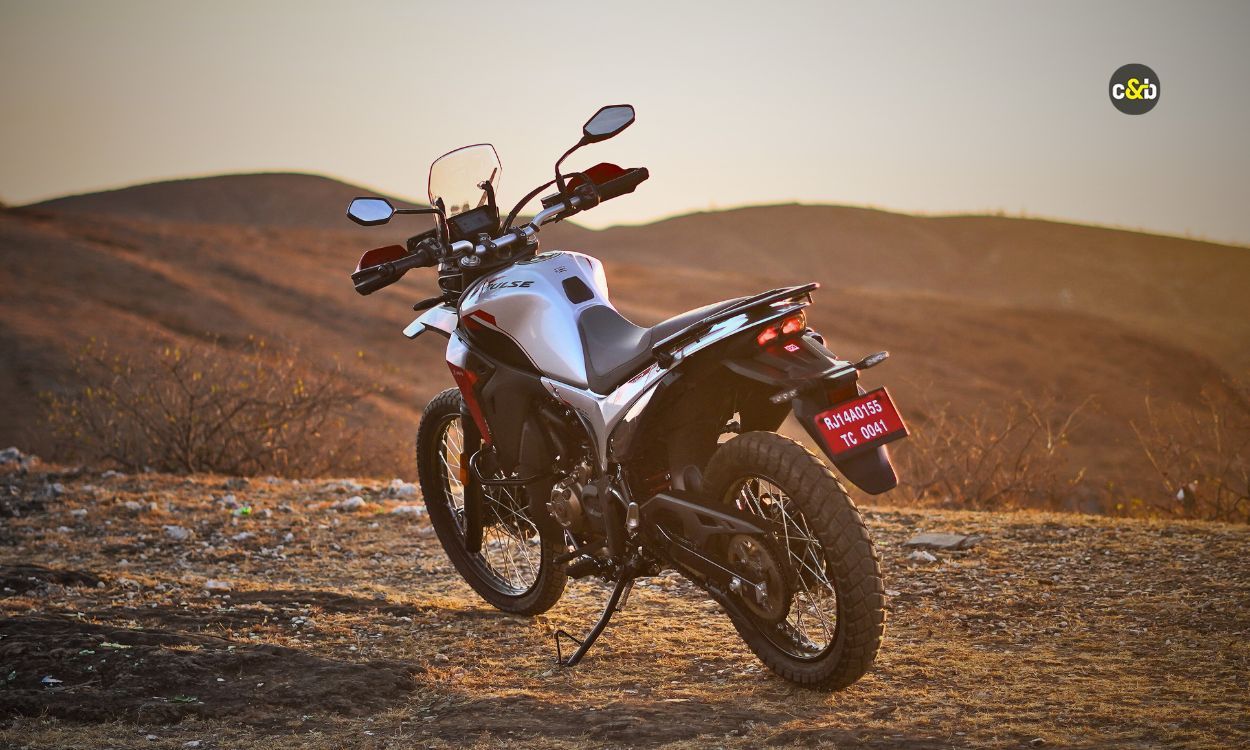
Dual-purpose motorcycles have gained a lot of popularity among Indian riders recently. Although the segment has seen rapid growth, enthusiasts have long been waiting for the options to expand in the Indian market. About eight months ago, Kawasaki answered that call by launching the street-legal KLX 230, but its steep ex-showroom price of Rs 3.30 lakh raised some eyebrows. Now, with the KLX 230 being locally manufactured, the price has dropped significantly by Rs 1.31 lakh, making it more accessible to buyers.
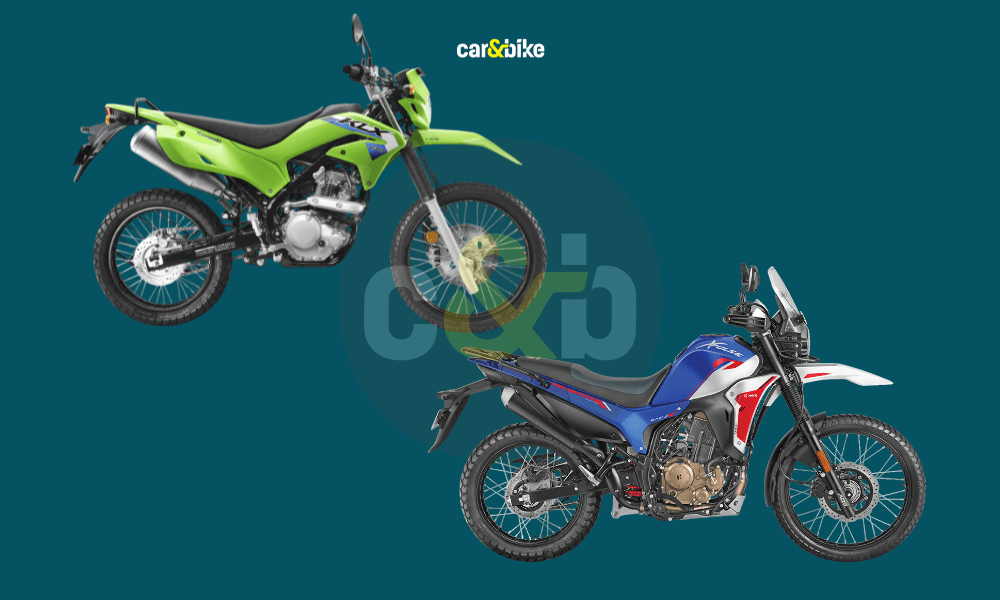
The made-in-India Kawasaki KLX 230 now comes with a lucrative Rs 1.99 lakh (ex-showroom) price tag, putting it right in the ring with Hero MotoCorp’s popular Xpulse 210. Let’s see how the two stack up against each other on paper.
Kawasaki KLX 230 vs Hero Xpulse 210: Specification check
Kawasaki KLX 230
Hero Xpulse 210
Engine
233 cc air-cooled single SOHC
210 cc liquid-cooled single DOHC
Max Power
18.74 bhp @ 8,000 rpm
24.26 bhp @ 9250 rpm
Peak Torque
19 Nm @ 6,000 rpm
20.7 Nm @7250
Gearbox
6-speed
6-speed
Kerb weight
139 kg
168/170 kg
Power-to-weight ratio
134.8 bhp / tonne
144.4/142.7 bhp / tonne
The Kawasaki KLX 230 and Hero Xpulse 210 cater to the same dual-purpose motorcycle segment. The KLX has a 233 cc air-cooled SOHC engine – a simpler, lower-cost design with one camshaft – while the Xpulse features a 210 cc liquid-cooled DOHC engine, which uses two camshafts for better performance and higher rpm. As for output, the Xpulse is ahead with 24.26 bhp vs the KLX’s 18.74 bhp, and it also makes more torque (20.7 Nm vs 19 Nm), though the KLX delivers it lower in the rev range, which can feel more responsive off-road.
However, the Xpulse fights back with a better power-to-weight ratio (up to 144.4 bhp/tonne vs 134.8 on the KLX), meaning it could feel quicker overall. In short, the KLX is simpler and lighter, while the Xpulse brings more power and tech to the mix. Both bikes have a 6-speed gearbox.
The price difference between the two is Rs 13,000 at the top-spec.
Kawasaki KLX 230 vs Hero Xpulse 210: Dimensions and Weight
Kawasaki KLX 230
Hero Xpulse 210
Kerb Weight
139 kg
168/170 kg
Seat Height
880 mm
830 mm
Fuel Tank Capacity
7.6 litres
13 litres
Wheelbase
1,370 mm
1446 mm
Ground Clearance
255 mm
220 mm
The Kawasaki KLX 230 is significantly lighter, weighing 31 kg less than the Hero Xpulse 210 (139 kg vs 168–170 kg). It also has a 50 mm taller seat height at 880 mm, compared to the Xpulse’s 830 mm, while the Xpulse remains more accessible for a wider range of riders. However, the suspension on the KLX compresses noticeably as soon as the rider gets on, which effectively reduces that seat height by a few mm.
When it comes to fuel capacity, the Xpulse offers more with a 13-litre tank, nearly double the KLX’s 7.6 litres. The wheelbase is longer on the Xpulse at 1446 mm versus the KLX’s 1370 mm. That said, the KLX provides 35 mm more ground clearance (255 mm vs 220 mm), which is a clear benefit for clearing obstacles.
Cycle parts are more or less similar on both machines.
Kawasaki KLX 230 vs Hero Xpulse 210: Cycle Parts
Kawasaki KLX 230
Hero Xpulse 210
Front/Rear Shock
Telescopic fork/ Monoshock
Telescopic fork/ Monoshock
Travel Front/Rear
220mm/223mm
210mm/205mm
Tyre size front
21-inch wire spoke
21-inch wire spoke
Tyre size rear
18-inch wire spoke
18-inch wire spoke
Brakes front
290 mm petal disc
276 mm petal disc
Brakes rear
230 mm petal disc
220 mm petal disc
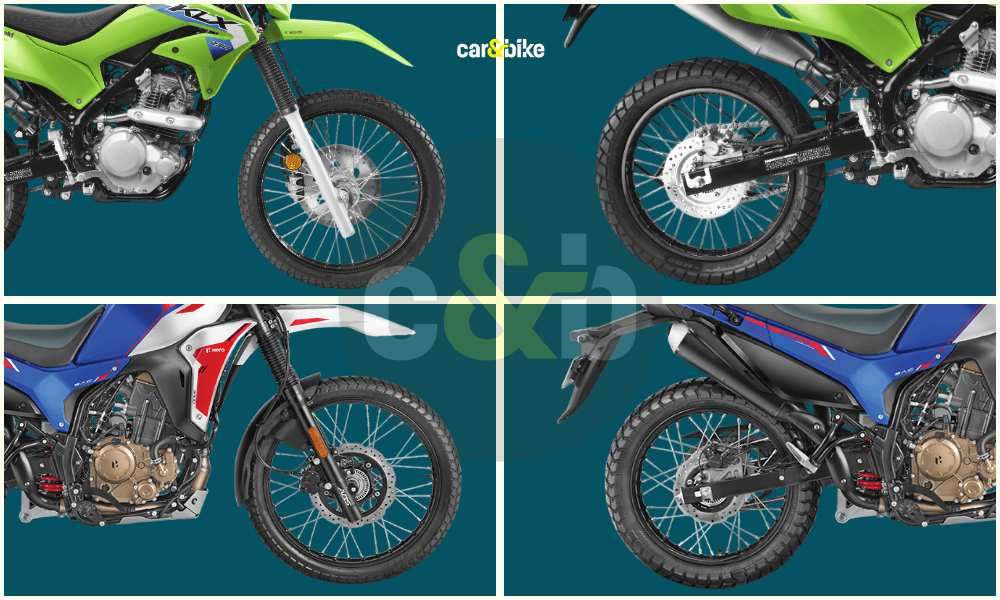
Both the Kawasaki KLX 230 and the Hero Xpulse 210 come equipped with a telescopic fork up front and a monoshock at the rear, but the KLX offers slightly more suspension travel, 220 mm front and 223 mm rear, compared to 210 mm and 205 mm on the Xpulse. This gives the KLX a bit more cushion over rough terrain, though, as mentioned earlier, its suspension tends to sag noticeably when a rider gets on, which could slightly reduce the usable travel.
In terms of wheels, both bikes ride on 21-inch front and 18-inch rear wire-spoke wheels. For braking, the KLX takes the lead with a slightly larger 290 mm front disc and 230 mm rear, compared to the Xpulse’s 276 mm front and 220 mm rear discs. However, do note that the KLX 230 is offered with single-channel ABS, while the Xpulse 210 not only comes equipped with dual-channel ABS but also gets 3 modes for it.
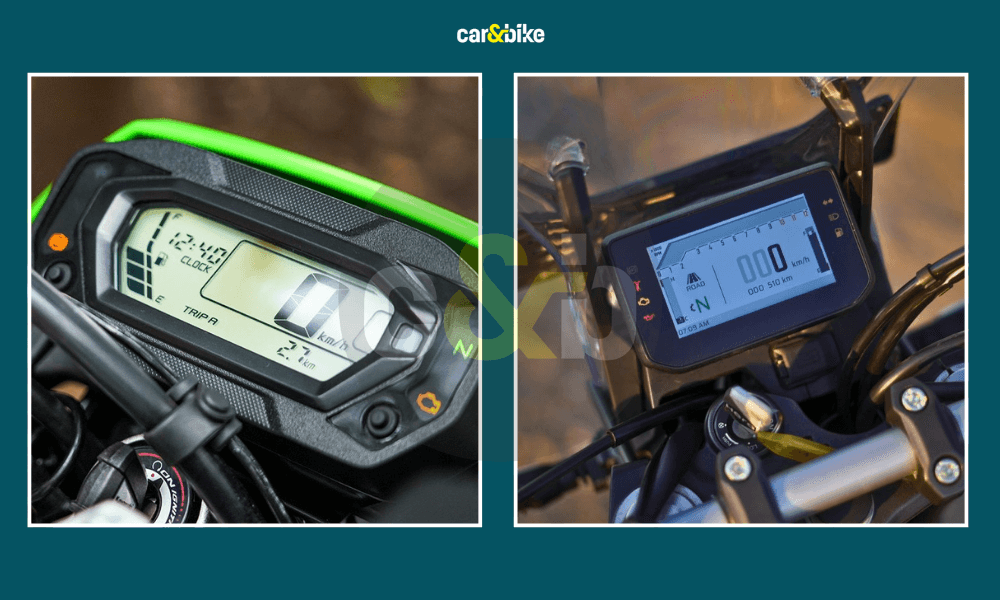
The KLX 230 is available in a single variant with an LCD unit, while the Xpulse 210 comes in both LCD and TFT dash options, depending on the variant.
Kawasaki KLX 230 vs Hero Xpulse 210: Features
The Kawasaki KLX 230 and Hero Xpulse 210 aren’t tech-heavy machines, but since many riders might end up using the two for daily commutes (especially the Xpulse) as well, both come with a few handy features. The KLX keeps things simple with a digital LCD showing essential readouts while also offering Bluetooth connectivity and app-based functions. It features Kawasaki’s ‘dual-purpose ABS’, tuned for both on-road and off-road use, and includes a switch to disable front ABS for off-road riding.
The Xpulse 210, which received a recent update, comes in two variants: base and top. The base gets a 4.2-inch LCD, while the top variant steps it up with a 4.2-inch TFT screen. Like the KLX, it also includes Bluetooth connectivity with full app-based functionality. Moreover, as mentioned earlier, the Xpulse features dual-channel ABS with three selectable ABS modes.
The Xpulse 210 gets a fuel tank nearly twice the size of the KLX 230.
Kawasaki KLX 230 vs Hero Xpulse 210: Price
Kawasaki KLX 230
Hero Xpulse 210
Prices (ex-showroom)
Rs 1.99 lakh
Rs 1.76 lakh – Rs 1.86 lakh
Lastly, coming to prices. The Hero Xpulse 210 is the more affordable option, with ex-showroom prices ranging from Rs 1.76 lakh to Rs 1.86 lakh, depending on the variant. The Kawasaki KLX 230, on the other hand, is priced at Rs 1.99 lakh (ex-showroom), making it around Rs 13,000 to Rs 23,000 more expensive. The KLX 230 most recently received a massive price cut from Rs 3.30 lakh to Rs 1.99 lakh, thanks to Kawasaki, as it is now made in India. The price slash brings the KLX much closer to the Xpulse, making it a more attractive option.
from carandbike - News https://ift.tt/bHRw5Jr
via IFTTT
Ola Electric is all set to unveil two new products today at its Sankalp event. These include a new electric motorcycle (Diamondhead) and a performance-oriented derivative of its S1 electric scooter, named the S1 Sport. The Diamondhead, a sports tourer, will be based on the concept model showcased two years ago. Both models will reportedly be powered by Ola’s own made-in-India 4680 cells.
The production-spec model is expected to closely mimic the design of the Diamondhead concept
Ola has dropped multiple teasers of the Diamondhead over the past few weeks, which prove that the model will be almost identical to the concept on the visual front. Styling cues on the motorcycle include the horizontal LED daytime-running lamp strip up front, the LED headlamp pod, and a sharp tail section with a horizontal taillamp. Expected to be Ola’s most powerful offering to date, the Diamondhead will likely be a more expensive offering than the Roadster, which is currently on sale with prices ranging from Rs 1.05 lakh to Rs 1.40 lakh (ex-showroom).
Ola has also teased the S1 Sport, although only the silhouette of the scooter is visible in the teaser videos. The videos reveal that the scooter will sport a number of changes over the standard model, which include revised body panels which are edgier in appearance. The scooter is also expected to feature cameras at the front and rear. Other changes over the standard model will likely include a more powerful electric motor setup and bigger batteries.
from carandbike - News https://ift.tt/PbqB7Kn
via IFTTT
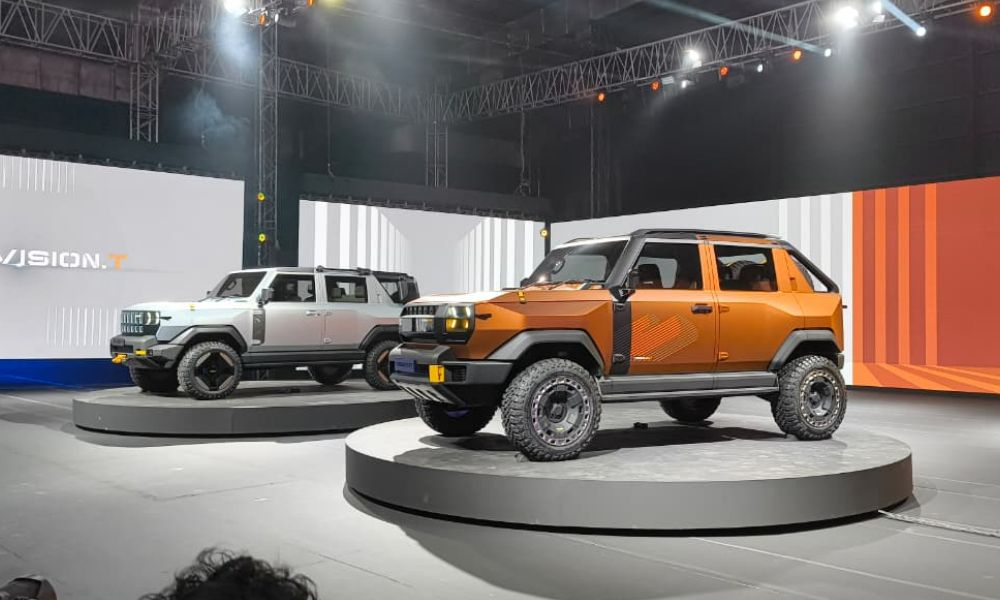
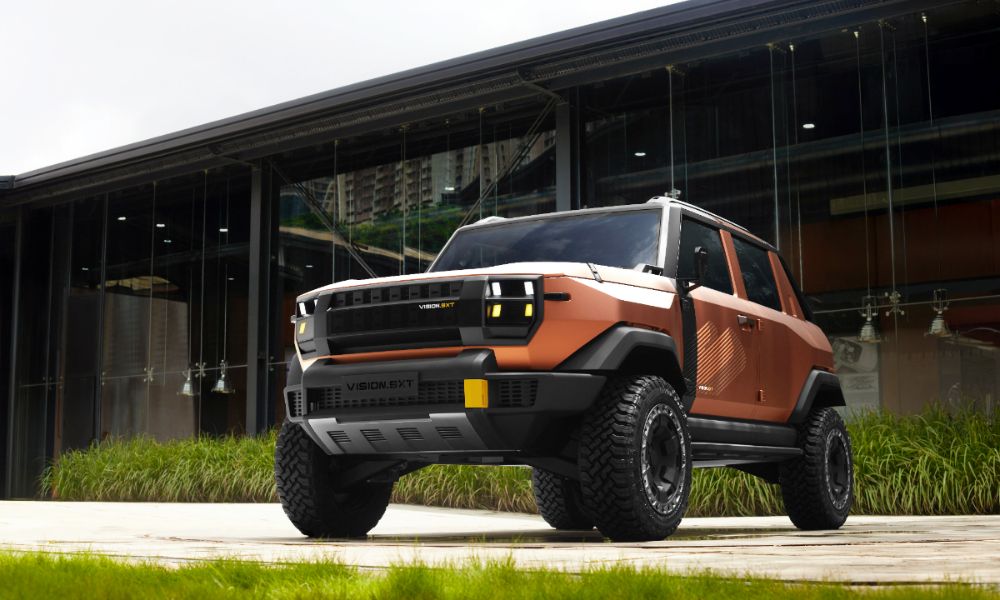
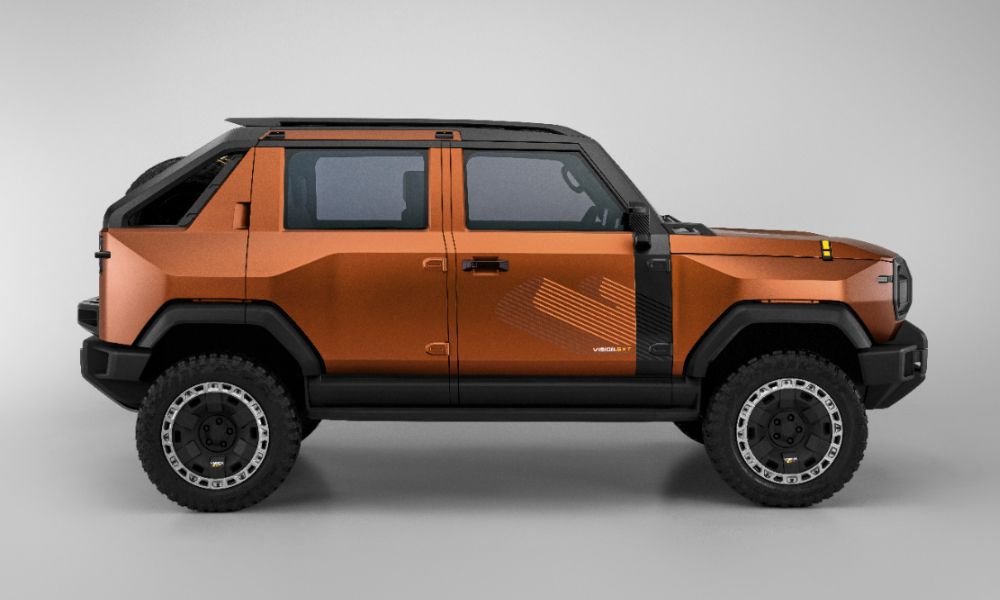
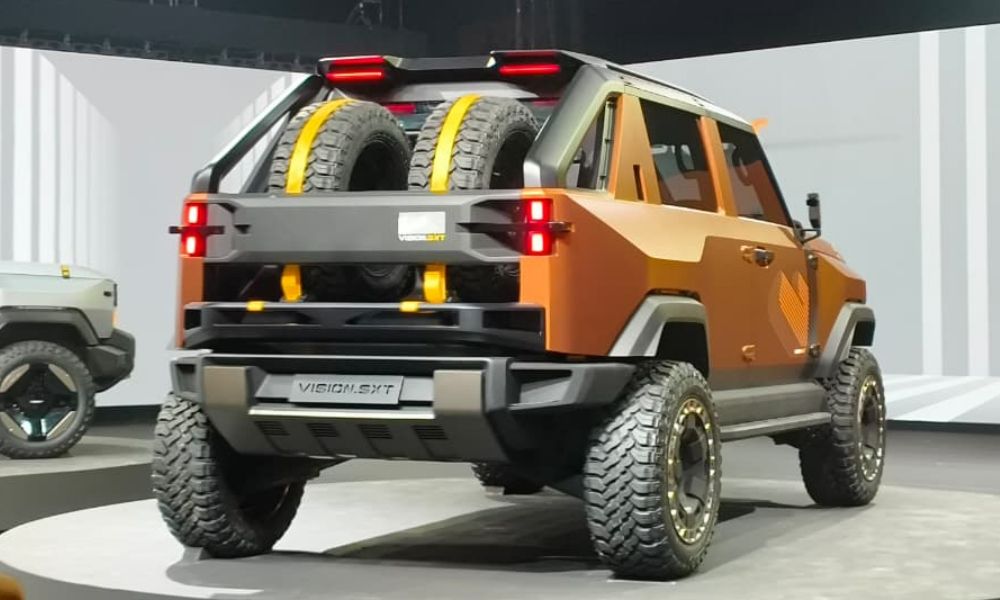
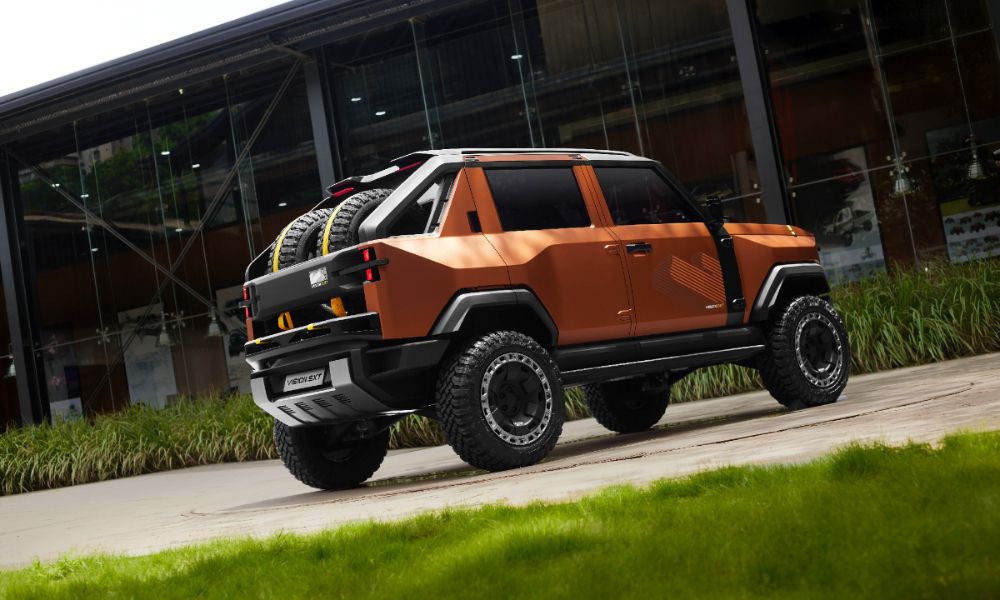
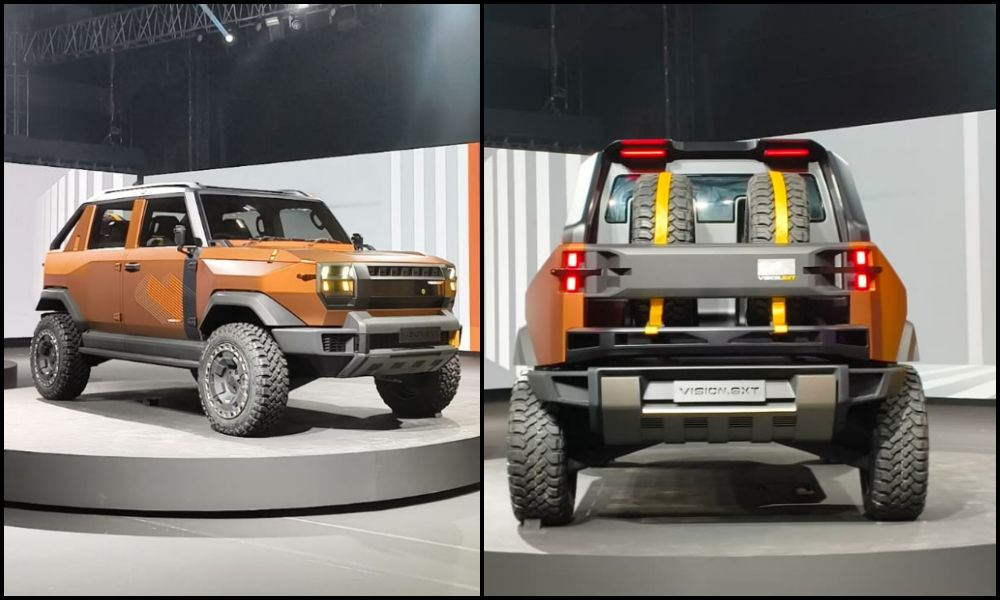
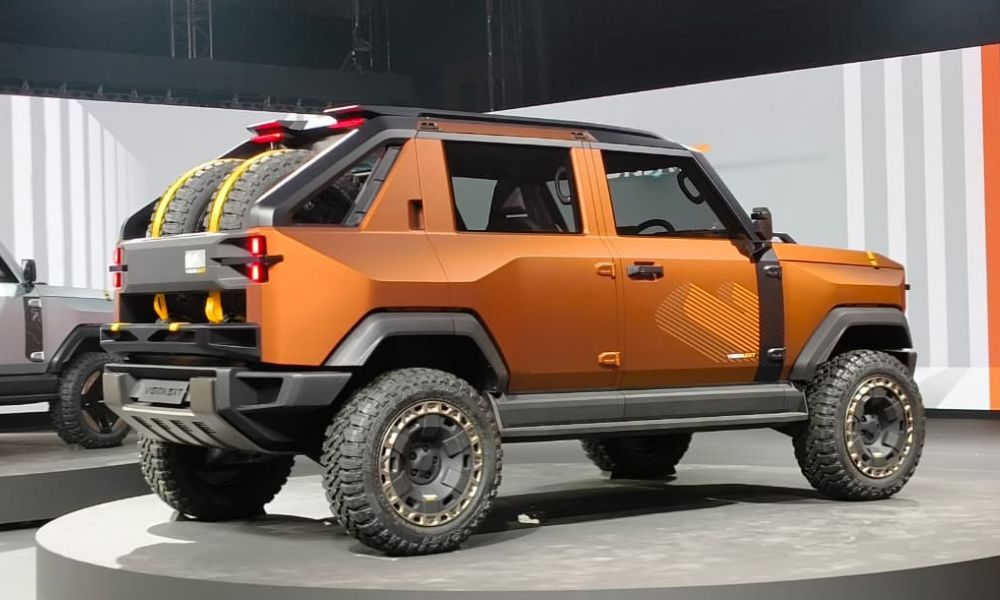
Mahindra unveiled the Vision SXT concept at its Freedom NU Independence Day event, alongside three other new concept vehicles. Based on the company’s modular NU_IQ platform, the Vision SXT is a derivative of the Vision T concept, which shared the stage. The SXT and T versions offer a glimpse into future additions to the Thar family, with a production version of the Vision SXT expected to be revealed sometime in 2027. Interestingly, Mahindra has also hinted at taking all four concepts to global markets.
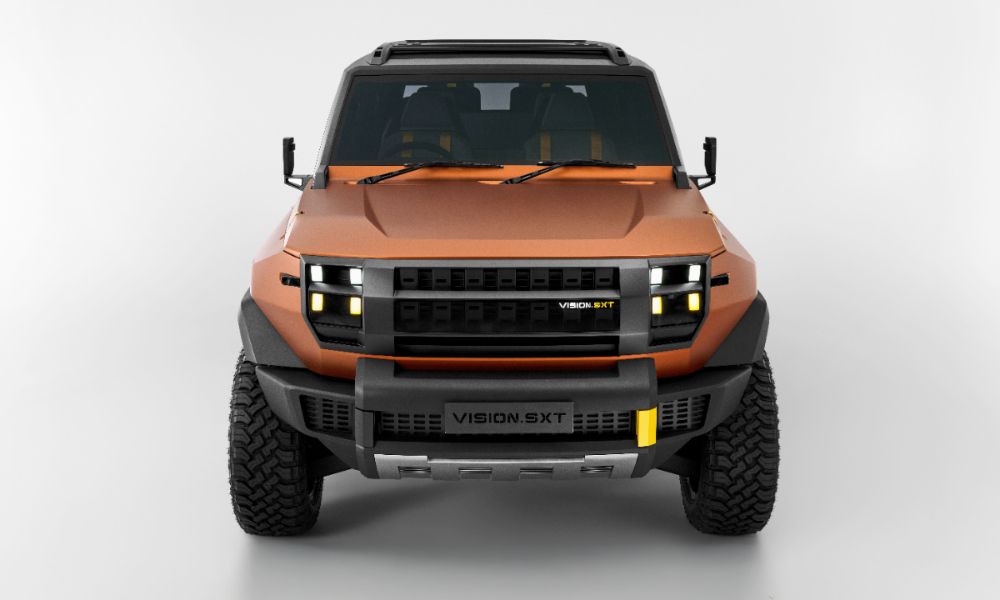
Starting with design, the Vision SXT shares several visual cues with the Vision T and bears resemblance to the Thar.e electric SUV concept that debuted two years ago.
At the front, it features squared lighting clusters with vertical LED accents integrated into a blacked-out grille.
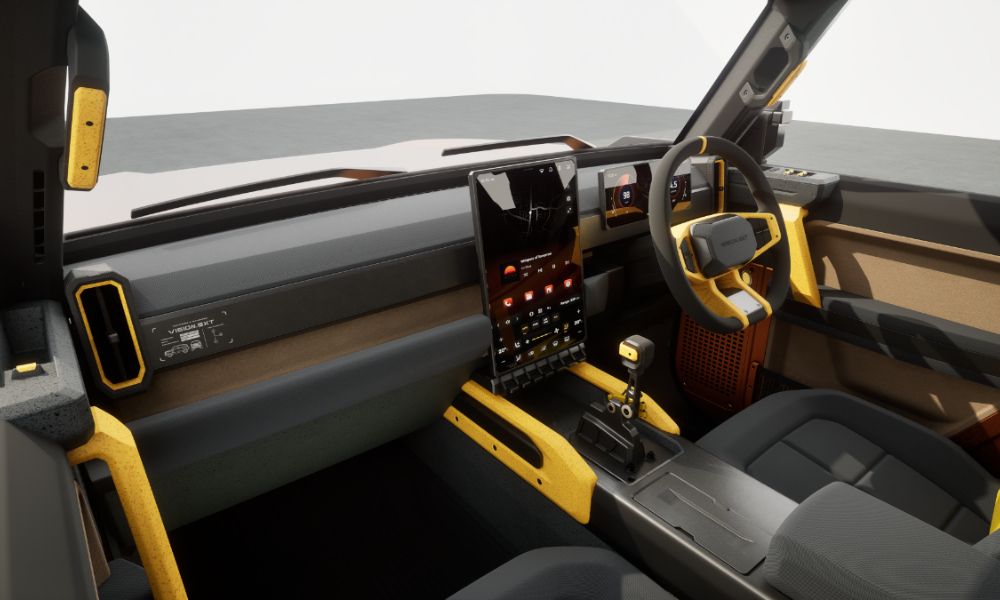
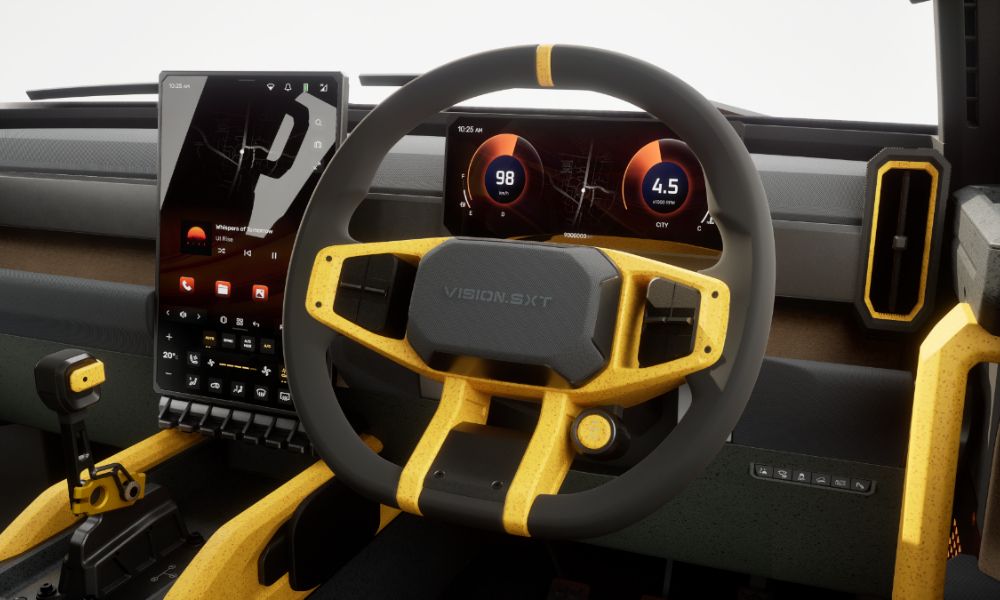
Coming to the interior, the concept gets a floating digital instrument display, a large portrait-style central infotainment screen, and physical controls below it.
Other elements include a new three-spoke steering wheel with the Vision SXT name on it. The air-con vents are vertically stacked on either end of the dashboard.
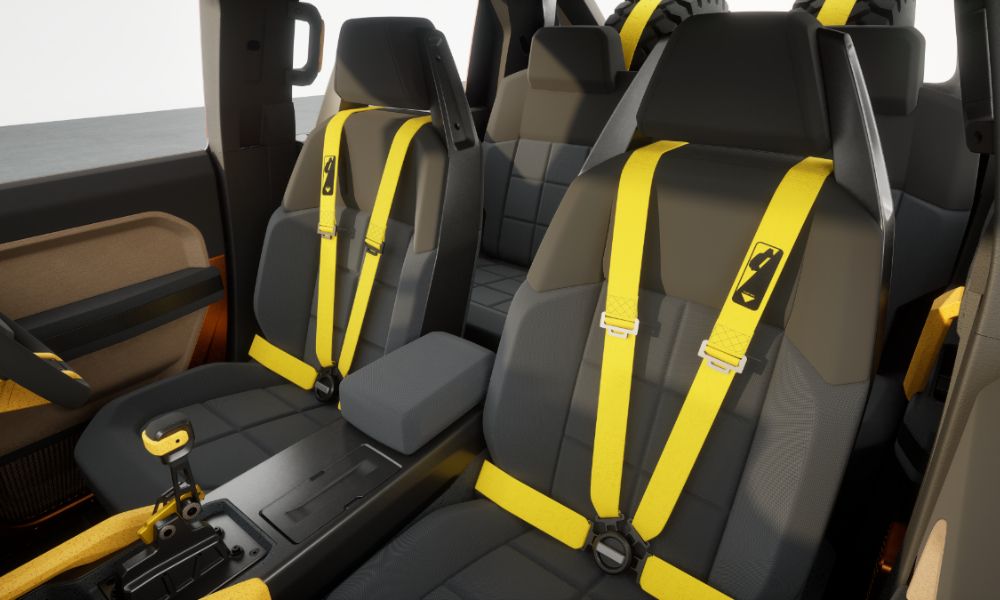
The entire cabin makes use of black as the base colour, while yellow does contrasting duties.
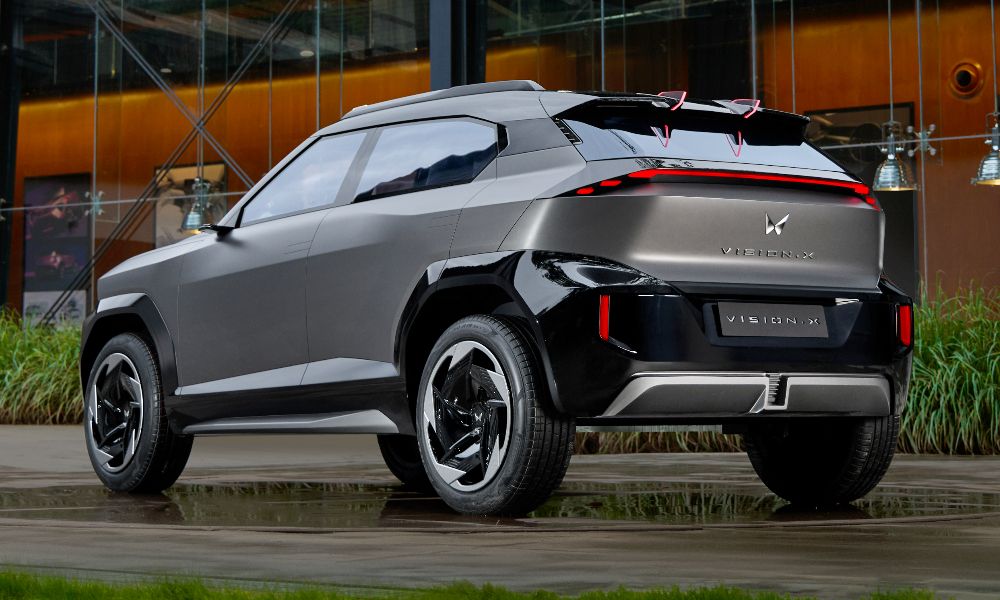
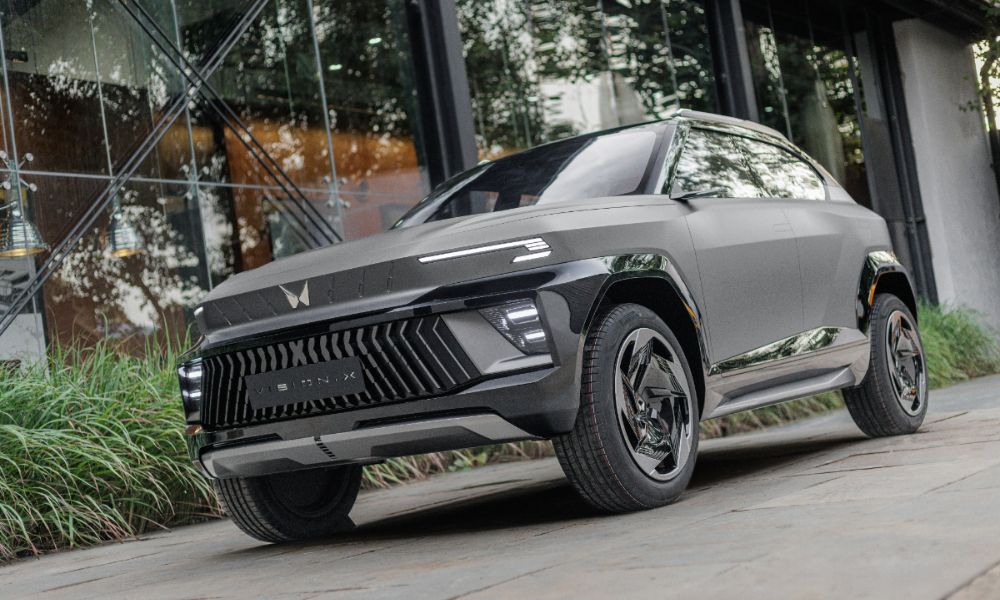
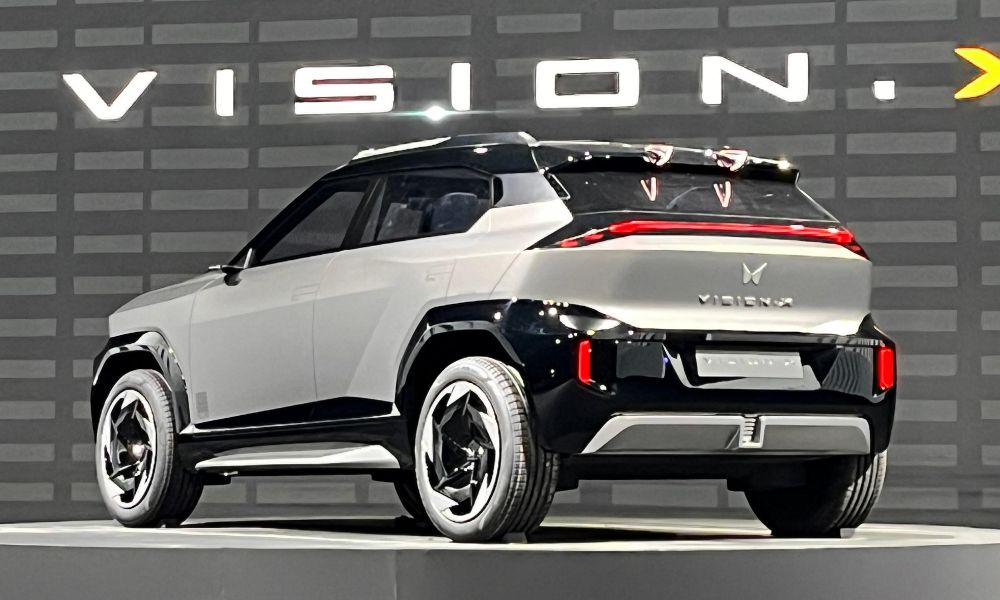
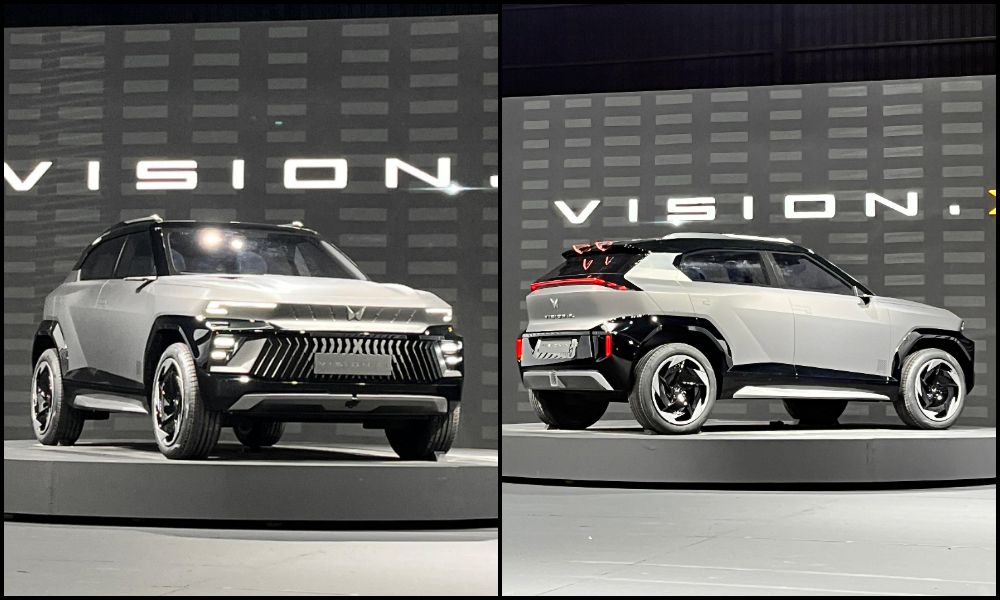
Mahindra Auto showcased the Vision X Concept during its Independence Day event, alongside three other new concept vehicles. Among the lineup, the Vision X appears to be the most compact, though its dimensions may be close to the Vision S. The crossover-style Vision X previews an upcoming model built on Mahindra’s new NU_IQ modular platform, which can support internal combustion, hybrid, and electric powertrains.
The Vision X concept features a sporty, crossover-inspired design with high ground clearance.
At the front, it sports boomerang-shaped LED daytime running lights, with vertically stacked LED headlamps sitting underneath. The Mahindra logo is centrally placed on a closed-off front panel, which features styling cues similar to those on the XUV 3XO RevX.
Moving to the profile, the concept features a gloss black, thick cladding around the squared-off wheel arches. The ORVM duties here are managed by cameras, akin to other concepts.
Akin to Mahindra’s other concepts, the Vision X features flush-fitting door handles and sharp-looking alloy wheels. It also includes a silver-finished sidestep.
At the rear, the design incorporates a sharply raked rear windscreen, giving it a coupe-like silhouette, along with a roof spoiler which is similar to the BE 6.
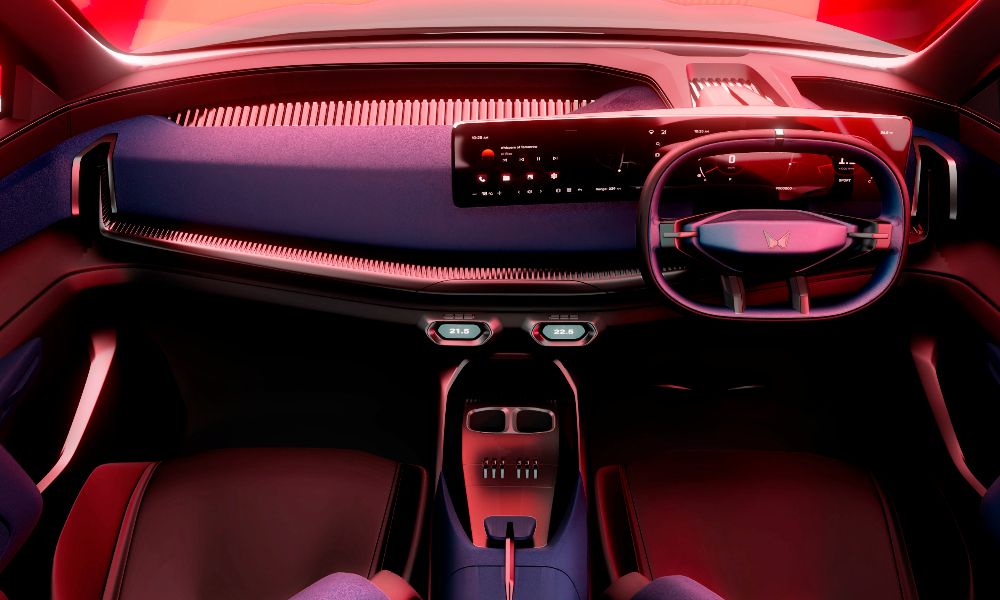
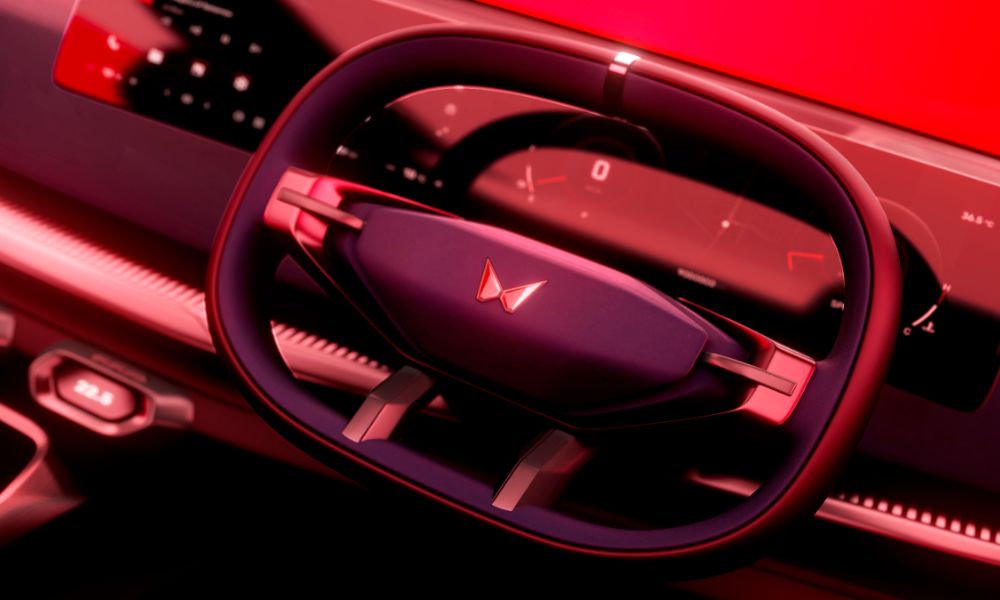
Coming to the interior, the Vision X adopts a minimalist cabin layout. The most notable feature is a combined digital display that serves both the instrument cluster and infotainment system.
Moreover, it gets a three-spoke flat-bottom steering wheel, a dashboard with vertical slat design, rectangular air vents, and a large centre console with integrated cup holders and storage space.
Mahindra is all set to unveil a range of new concepts today at its Freedom_Nu event, on August 15, 2025. The carmaker is set to reveal four new concepts today, namely the Vision.T, Vision.S, Vision.SXT and Vision.X. Mahindra has dropped multiple teasers for the vehicles over the past few weeks, although the teasers have only given us a minor look at the vehicles. Here’s everything we know about the vehicles so far.
One of the vehicles that will be showcased is the Mahindra Vision.T. Teasers have shown bits and pieces of the vehicle, which include wide wheel arches and off-road type block pattern tyres. We expect it to be an evolution of the Thar.e, the electric off-road concept Mahindra first revealed in 2023. Though it appears to carry the design of the Thar.e, the latest iteration of the concept is expected to get some changes on the exterior, which could make it look closer to the production version.
Mahindra Vision.S
A commanding gaze from the front! The Vision.S arrives in all its glory this 15th August. Get ready!
The Vision S is another concept vehicle that will be showcased at the event. While it is not yet clear what the Vision S will be, reports point to the vehicle either being the all-new Bolero, which has been spotted testing multiple times or a version of the Scorpio SUV, with either a hybrid or an all-electric powertrain. The teasers show a clamshell bonnet with what looks to be vents along the outer edges and an almost vertical fascia with what could be a vertically slotted grille. The concept also looks to have prominent wheel arch flares.
— Mahindra Automotive (@Mahindra_Auto) July 4, 2025
undefined
Mahindra will also debut the Vision SXT at the event. This model, however, is expected to be a heavy-duty pickup, which could be a more production-ready version of the global Pik-up concept vehicle based on the Scorpio N. During the debut of this concept two years back, it was mentioned that the vehicle would be released in a production-spec variant that will go on sale in 2025.
— Mahindra Automotive (@Mahindra_Auto) July 7, 2025
undefined
Another concept that will be unveiled is the Vision X, which is expected to be an all-new SUV. According to reports, the Vision X will be an all-new addition to the XUV lineup, and could even be the all-electric version of the XUV 700. Little is known about the concept, aside from the fact that it will feature a smoother design than the other vehicles to be shown.
from carandbike - News https://ift.tt/oFtMq34
via IFTTT





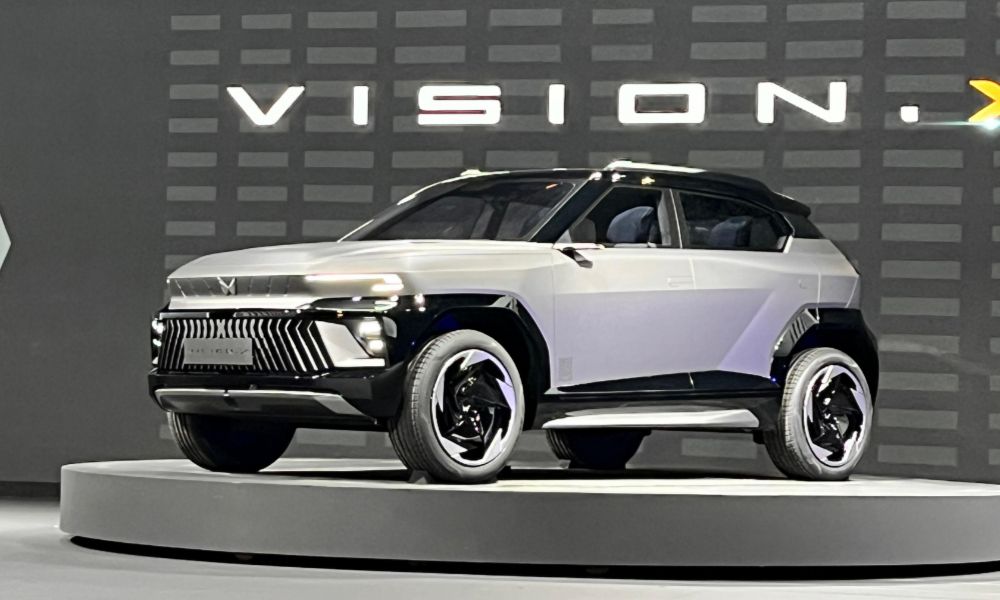
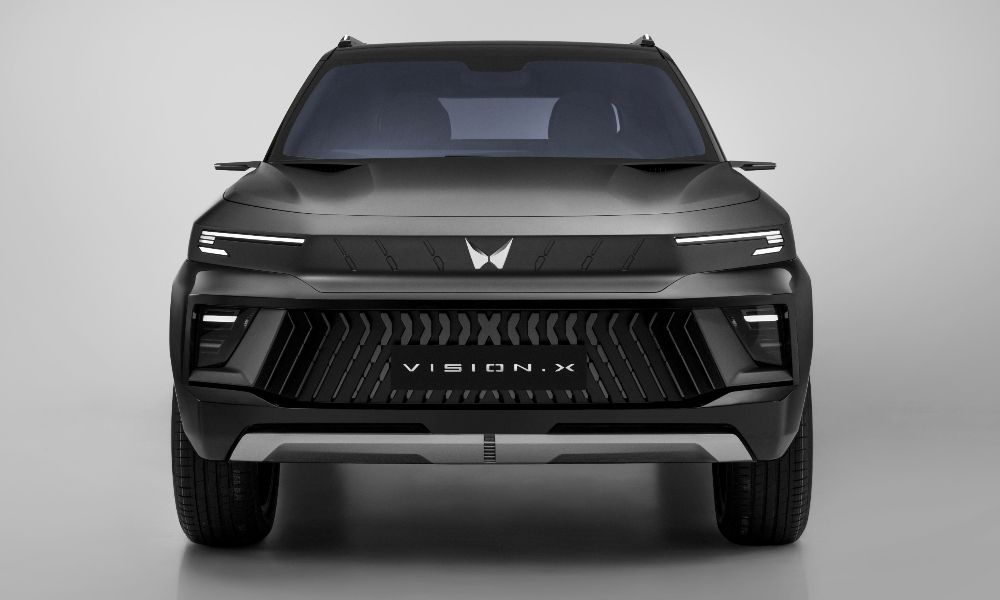
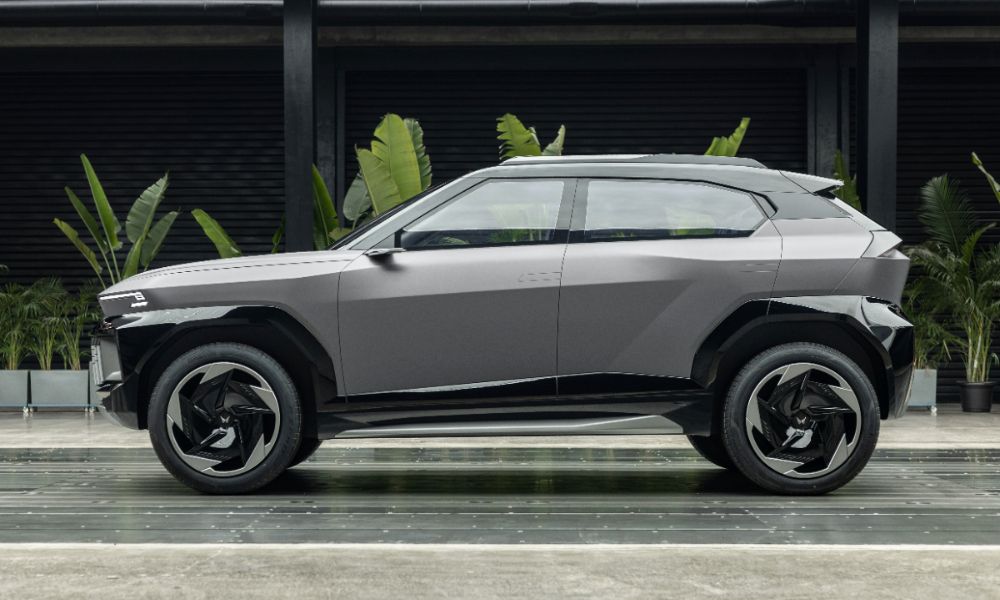
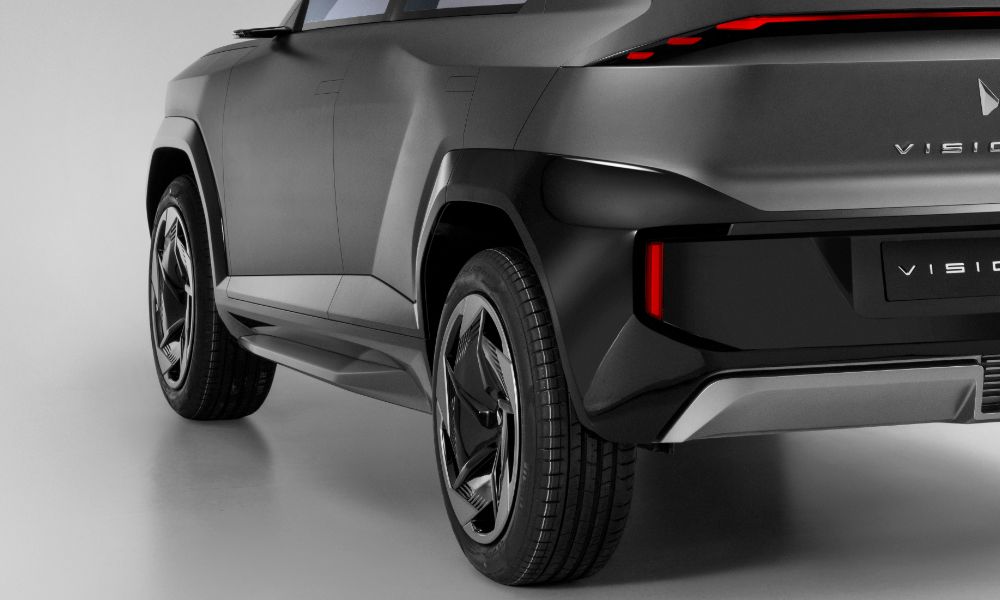
 Like the other concept models, the Vision X is built on Mahindra’s NU.IQ monocoque platform.